Wednesday, January 11, 2012

The Lost Symbol by Dan Brown

There would be some changes since I got my Kindle.  On this gadget, I found out that sometimes, in some books, the pages don't work.  Instead, you'll find 'location.'  And it's not really viable to use location 68 since sometimes, it's still with the table of contents, acknowledgments, etc.  So, better use the percentage.  Since Kindle uses the percent instead of pages.  And I'll call it halfway up.

Halfway:
I need that pyramid and capstone... and I'm running out of time.
Sato arrived at First Street just as a black Escalade SUV with dark windows raved across the double yellow and skidded to a top in front of her at ther rendezvous point.  A lone agent got out.
"Any word yet on Langdon?" Sato demanded. 
"Confidence is high," the man said, emotionless.
Before starting with this book, I searched goodreads.com and was wondering why it got only an average of 3.5 rating.  But after reading several pages, it seemed to me that there might be a reason why.

My first reaction was that it started in almost the same way as with the Da Vinci Code.  I nearly lost interest because of the similarity.  But I tried to go on and see more.

The next thing is that those lengthy information on backgrounds of certain things bored me.  I know that sometimes some information are needed to fill in the gap, but then, sometimes it's way too long that I started to lose grip of the story.

I hope things change somewhere in the middle... or sooner.

Sunday, December 18, 2011

The Last Song by Nicholas Sparks

First sentence:
Staring out the bedroom window, Ronnie wondered whether Pastor Harris was already at the church.

My favorite book written by Nicholas Sparks is definitely "A Walk To Remember."  Actually, if you'd probe deeper, I'll tell you that I like the movie better than the book.  I've read the book once and watched the movie several times and never tire watching.

Since I started my quest last 2009 to not read two books by the same author - at least not consecutively or at such a short interval - I never looked for anything written by Nicholas.  But wandering at the bookstore before Christmas, I found this book on trade paperback and could not resist not to buy it, for such a cheap price of Php 75.00 (about a $1.50).  So, since I wasn't reading anything at that time, I immediately started as soon as I got home and got the chance.

What's on page 68:
Will stood in the well beneath the Ford Explorer in his uniform, watching the oil drain while simultaneously doing his best to ignore Scott, something easier said than done.  Scott had been haranguing him about the previous evening on and off since they'd arrived at work that morning.
"See, you were thinking about this all wrong," Scott continued, trying yet another tack.  He retrieved three cans of oil and set them on the shelf beside him.  "There's a difference between hooking up and getting back together."

Tuesday, December 13, 2011

Gulliver's Travels by Jonathan Swift

The first sentence:
My father had a small state in Nottinghamshire:  I was the third of five sons.
Again, this is a random choice from a sea of eBooks.  I guess the title attracted me, too, because as a child, I saw bits and pieces of the story on tv, but never really sat down and watch it in its entirety.

All I know (as a kid) was that he was captured by these little people in the land called Liliput.  I could still remember Gulliver lying down with these little people climbing the stairs that was placed somewhere in his torso.  I do not recall hearing a line said by any of the characters though.  Probably because I was only half-attending to the tv at that time and that I really wasn't interested.

I told a reading friend what I was reading lately.  He is reading Paul Theraux.  He told me good luck on reading Gulliver and I don't really know what he meant.

I replied that I chose the book by random and was only filling the vacuum.  I was on page 58, and at that time, Gulliver had just escaped the land of little people.

I told my friend that I thought it was kid's stuff.  But I thought it wrong when I reached page 110.  It totally changed my thoughts about the book.  Yes, it could be for the young adult, but I guess I am really wrong in calling it kid's stuff.

What's on page 68:
The farmer, by this time, was convinced I must be a rational creature.  He spoke often to me, but the sound of his voice pierced my ears like that of a water-mill, yet his words were articulate enough.  I answered as loud as I could in several languages, and he often laid his ear within two yards of me:  but all in vain, for we were wholly unintelligible to each other.  He then sent his servants to their work, and taking his handkerchief out of his pocket, he doubled and spread it on his left hand, which he placed flat on the ground with the palm upward, making me a sign to step into it, as I could easily do, for it was not above a foot in thickness.  I thought it my part to obey, and for fear of falling, laid myself at full length upon the handkerchief, with the remainder of which he lapped me up to the head for further security, and in this manner carried me to home to his house.

Friday, December 9, 2011

He made it around the world

This is my last post for this book.

So, with all the efforts and all the means, Phileas Fogg made it around the world.  Together with Aouda and Passepartout, he ended up in London not via the China but through some other else's boat.

I leave it up to you if he made it in eighty days.

The adventure was worth the reading.

I know this is classified as a 'young adult' book, but I didn't really mind reading it.  I actually enjoyed reading the book and really couldn't wait to find out how it will turn out.

The meridian has always been pointed out in this book.  Passepartout was lectured on the meridian but like me, I didn't really pay too much attention about what Jules Verne was trying to say.  All I know is what Jules Verne calls the meridian is the time zone in my simple terms.  But I was really glad to know that time zones are actually meridians.  I didn't realize it until I read this book.

Talking about Passepartout, I guess I shouldn't have questioned his loyalty to his master.  I guess it served its purpose that he didn't tell his master about the thing he discovered while on the journey.  This might have turned everything on the wrong side of things.  This gave me the lesson of not always getting too emotional on things.

What happened to Aouda and Phileas is not something of a surprise really.  Although I haven't paid too much attention about them most of the time, I know that there is a coming out for this after Phileas Fogg accomplished his goal.  One thing that was a bit surprising for me though, was how the coming out was revealed.

I am sort of tongue-tied as to the developments on this book.  I want to avoid spoilers so my apologies for talking only about bits and pieces of the whole journey.

I suggest you read the book.  It's short, but full of adventure.

The last sentence:
Truly, would you not for less than that make the tour around the world?

On Trains as a Mighty instrument of progress and civilization


Thus, we celebrated the inauguration of this great railroad, a mighty instrument of progress and civilization, destined to link together cities and towns which do not yet exist.
This train ride of Phileas and the rest of the group made me think back when I was young.  I remember taking the trip from Manila to Possirubio, Pangasinan as a way to get us to Baguio for the first time.  I remember looking at the window and seeing rice fields as the train passed by.  At this point, I was a kid with no idea what is Baguio and how far was it from where we were.  I also remember enjoying the train ride more than the bus from Possirubio to Baguio.  The bus ride was boring.  But the train ride compensated.

Still with trains, I wonder why this form of transportation was never given importance by our government.  When I was in college, I remembered that there were almost no trains operational in the country.  I wonder if the government paid more attention to building railroads from Manila to the other points of Luzon.  Would our country have been more progressive today with all those trains?  I believe so because I believe in what Jules Verne said that it is a mighty instrument of progress and civilization.

Crossing the bridge

Passepartout's idea would have been the most prudent after all.

But the other passengers didn't think as him.  They all wanted to cross the bridge as soon as possible.  Well, Passepartout also wanted to.  At this time, his sentiment goes out to his master and sometimes, he is even more anxious than his master to get their goal done.

I am not sure though whether he thought about what would happen to the bridge after doing what the others wanted to do.  But his idea would have done less harm to the bridge.

The Medicine Bow collapsed after their train made it through at the move suggested by the majority of the passengers.  The train made the leap and Passepartout was not even heard of of his plan.

With this, I commend Passepartout's thinking.

Wednesday, December 7, 2011

Oh, you, Passepartout!

Passepartout got himself into trouble and I believe this is because of the fact that he has not been telling things to his master.  But sometimes I can't blame him for he doesn't really know what his master is really into.

He was separated from his master and found himself alone in Japan.  Alone... and hungry with not a shilling in his pocket.

But his master found him again:  His master exhausted all his efforts to find him.  And I was really quite surprised that the master did not even ask him what happened.  He told his story and his master believed him outright.  And I am not happy that he did not exactly tell his master what really happened.

But if there is one thing that I could not believe at this point, it is the fact that after all that happened to him because of Detective Fix, he could still say:  No, they are not friends, but they could do be ALLIES.

How dare you, Passepartout!

I fear of dreaming of wringing Passepartout's neck when I sleep tonight.

Passepartout

I never paid attention to him when they left London.

But when his actions became quite noticeable, I began to take note of him.

What happened at the temple annoyed me although it wasn't enough to make me hate him.  Maybe because of the fact that they or he got away with it.  But, did he really get away with it?  We may soon find out in the coming days.

But I grew more and more concerned about his relations with Detective Fix, more than I am concerned with his relationship with his master.  I don't know if his master never even bothered to tell him more about the trip.  But if it was me, I would have told him things from time to time.  Of course we didn't have enough time leaving London, but once we set out, things should have been said time and again.

Though I couldn't blame his master.  He was very concerned about his goal that he really couldn't care less about other things.  His indifference is probably one thing.  But it also pays to be a little in touch with things.

Right now, they are both on bail.  For something that his master never even cared to know the details of.  He probably thinks there will be enough time to think about it once they got back to London.  Because the thing right now is just to get back there in time.

Meanwhile, I don't know how far could Passepartout figure out what is really happening.  I just wish he figures out more so that he could be more careful.  He needs to gather his senses before I start dreaming of confronting him and telling him to just shut up.

Monday, December 5, 2011

The book and my coffee time with a friend

I should have seen it coming.

Yesterday, I met with a friend who had just been to a trip to the Holy Land.

And for all of you who knew about it, I guess you'll say that the Suez Canal is part of that trip.  Well, my friend has been there and told me about that connecting route that was just built recently.  That connecting route was supposed to take you from one continent to another - Asia and Africa in just a matter of short time.  At least that's how I understood it.  I admit that it's really funny that I somehow couldn't relate.  I understand her fascination about the whole trip so I didn't want to mess with her enthusiasm.  Because somehow, I know I would have felt the same thing had it been the other way around.

So, now, the more I need to google and learn more about not only the Suez Canal itself, but right now, I think I want to know more about the Holy Land.

I requested her get some pictures of the highlight of the trip and put it on her iPad so that next week, when we meet for coffee, she could show me the pictures of (at least) some of those places that they've been into.

It was really timely that I get to choose the book to read nowadays.  At least, her trip to the Holy Land is still fresh and I am still savoring Phileas Logg's supposed adventure of the world.


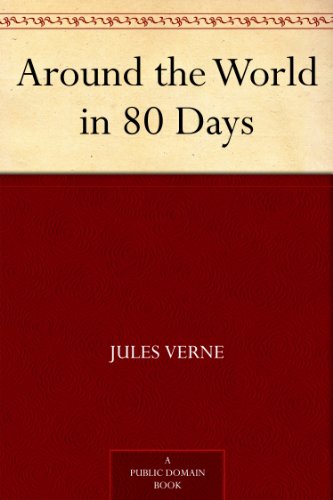
Around the World in Eighty Days by Jules Verne

The first sentence:
Mr. Phileas Fogg lived, in 1872, at No. 7, Saville Row, Burlington Gardens, the house which Sheridan died in 1814.
And this is my second eBook random choice for this year.

Image copied here
I guess I am longing for an adventure that's why I randomly selected this book.  I turned to planetebook.com for a short list of eBook titles, and went to goodreads.com to download their version.  This is the most convenient way so far since keeping track of the pages won't be a problem if I downloaded the books from goodreads.  But of course, you can also get it from planetebooks if you're not really particular about the pages.

Anyway.

I guess I've been wanting to travel that's why I randomly selected this book.  It's like I imagine myself travelling around the world in just eighty days without leaving my home.  I guess this is also the product of watching too much TLC on tv.  Anthony Bourdaine was in Italy the last time I watched and I was really fascinated about the lifestyle of the folks there.  They still make their own cheese, grow their own cattles, extract their own pork lard, make their own pasta, and call themselves as the best makers of their own produces.  How I wish I could taste them for real.

So, that's tv.  But with books, I want it to take me back in time.  And this book took me back in those days when it took days to get from one country to another (when now it's only hours) and read about how it looked like at that time.

I am already on page 29 at the time of this writing and the boat Mongolia with Phileas aboard was just about to get to the Suez Canal.  This brought me to google about the canal since I wonder why there seems to be many Africans on board.  Yeah, yeah, I need to learn more about geography.  And maybe that's why I chose this book, too.

At page 68:
Phileas Fogg, self-composed as if the judgment did not in the least concern him, did not even lift his eyebrows while it was being pronounced.  Just as the clerk was calling the next case, he rose, and said, "I offer bail." 
"You have the right," returned the judge. 
Fix's blood ran cold, but he resumed his composure when he heard the judge announce that the bail required for each prisoner would be one thousand pounds. 
"I will pay it at once," said Mr. Fogg, taking a roll of bank-bills from the carpet-bag, which Passepartout had by him, and placing them on the clerk's desk.

Sunday, December 4, 2011

I guess I am not yet ready for Thomas' rainbow

And with this, I decided to just rest for a few days before I start a new book again.  Be it an eBook or not.

It was such a tough decision.

I wanted to continue with the book.  But I really couldn't.  In spite of the encouragements I read from Twitter and commentators from Goodreads.com, it was really hard for me.

I don't know if I am just using my condition as an excuse right now to finish the book.  But sometimes, really, I find it hard to dig through his statements.  Those many characters and descriptions just messes up the story for me.  I find it hard to remember who's the psychologist, his girlfriend, that Mexico is a name and not a place or a country.  And I also need to remember what Mexico does, or if Mexico even has a girlfriend.

The funny thing is by default, goodreads.com has only three choices:  read, to-read, reading.  And then I discovered you can add another category.  And that was my deciding point.  At the moment that I found out I can make a category 'Unfinished,' I knew it was my sign that I had to stop with the book.  See the list here for my categories.

This brings to mind my high school classmate where I actually learned the book from.  In one of his comments years ago, I remember him saying that after reading more than half of the book, he still doesn't know if he's getting it.  Since we lost touch years ago, too, I wonder if he ever finished... until now.

Maybe I should send him an e-mail and ask.


As in any dream, I woke up...

This post is the last for this book.  And this has long been overdue.  I didn't have the time to write before I got admitted for my seventh cycle of chemotherapy that's why I am writing this just now.

My first reaction is that maybe I am just a little too old for this book.  But I have this idea that no book is to passe for anyone.  No book is old nor new for someone who wanted to read, who wanted to experience.  But sometimes, it just has a difference if you read the right book at the right age.  I know I would have had different reactions in some of the scenes had I read it when I was younger.

Anyway.

I found it fascinating that the the characters were all made of cards.  I initially thought it kind of funny.  But the fascination continued when the cards have their numbers as their names, and that they have their own roles in the adventure.  The knave was tried for something that I didn't even find out if he did or did not do.  I don't really know if I wasn't just paying too much attention to the book or the book really didn't tell.  This happens to me every once in while.

Anyway, this book reminds me of a local movie.  That one with Ai-ai delas Alas entitled "Ang Tanging Ina" where all the offsprings of the mother were named by numbers.  But of course, not to be to obvious, it was Uno, Dos, Tres and so on.

The last sentence of the book:
Lastly, she pictured to herself how this same little sister of hers would, in the after-time, be herself a grown woman; and how she would keep, through all her riper years, the simple and loving heart of her childhood; and how she would gather about her other little children, and make their eyes bright and eager with many a strange tale, perhaps even with a dream of Wonderland of long ago; and how she would feel with all their simple sorrows, and found a pleasure in all their simple joys, remembering her own child-life, and the happy summer days.


I don't know if I ever mentioned (since I have been very forgetful these days, that I read this on e-Book.  And here is the link:


Goodreads.com

Friday, November 25, 2011

Alice's Adventures in Wonderland and Through the Looking Glass by Lewis Carroll

I have been reading using natural light for about a while now.  So, that meant I have most of my reading time in the afternoon when the sunlight is strong.

So, recently, when we have been having grey and gloomy days, I decided to use the computer so that I can read even if the lights are low.

Image copied here
I turned to Google Books to find an e-Book that I could start reading and I figured that I would not search or try to choose from a million books.  I'll just start reading the first book that I could lay my cursor into.  And this is what I found.

The first sentence:
Alice was beginning to get very tired of sitting by her sister on the bank, and of having nothing to do:  once or twice she peeped into the book her sister was reading, but it had no pictures or conversations in it, "and what is the use of a book, " thought Alice, "without the pictures or conversations."
For some, this was a reading requirement maybe in grade school, or a bedtime story that their parent(s) read to them.  But since I went into a public school here in our country, reading a novel was never a requirement - even if it was a book by a local writer.  So, part of my quest was to read these classical books that inspire children to read and write.  My parents never read to us during bedtime.  But it was never a problem for me.

It's a good thing that I got myself into reading even if it wasn't a requirement in school.  I guess it was my dad's persistence that I read his collection of Reader's Digest - a collection which he kept so that we, his children could have something to read on.

Anyway.

Since it's an eBook, I don't have an image that I took of myself.  This is the image cover that I took from the site where I downloaded the book itself.

Here's what's on page 68 of the book:
"He must have imitated somebody else's hand," said the King.  (The jury all brightened up again.) 
"Please, your Majesty," said the Knave, "I didn't write it, and they can't prove that I did: there's no name signed at the end." 
"If you didn't sign it," said the King, "that only makes the matter worse.  You must have meant some mishief, or else you'd have signed your name like an honest man."

Thursday, November 24, 2011

Gravity's Rainbow by Thomas Pynchon

The first sentence:
A screaming comes across the sky.
I bought this book back in 2009, when I was still in Dubai.  I read about the book from a high school classmate who is also into reading classic novels.  Somewhere in his journals, I read that he was already somewhere in the pages of the book and still couldn't understand a lot of things.  I'm afraid this is happening to me now.  I'm already a few pages on, and still, I couldn't seem to dig the author.

Apart from the many characters of the book, there are a lot of (what I call) insertions that distracts me from the plot of the story.  At least that's what it is to me.  I am close to putting it off and not finishing it when I decided to read the comments of the readers of the book from goodreads.com.  One of them gave several advises and one of the advises was to have a little patience, at least until you reach the second part.

I am still a long way from the second part (I am only on page 64 of 902 pages), and I am trying to gather all the patience I have in putting it off and not finishing it at all.  At these point, a lot of characters are being introduced and the only one I can remember was the psychologist (whose name I need to remember).  There's a guy named Mexico who at first I thought was the country.  And there's a girl in a relationship with one of the characters.  Again, I need to remember her name.

Still, one of the advises said that it would be better to read the V book first.  But I don't think I'd go through that.  I am in this reading quest where I am to read one classic book from one author and that's it.  I just need to experience the author, his style, the way he makes the story, and how the world looked like at the time he wrote the story.  That's just about it.  Now, if Thomas Pynchon wrote about the future, then I may have a little problem with that.  Because one of the reasons why I am reading classical novels is to read about the past.

I guess I may have bought the wrong book for my quest.  But I still have the patience to read it right now.

I don't know how further more my patience will take me.  But I do hope that it's all worth it.

What's on page 68:
Mind to mind, tonight up late at the window while he sleeps, lighting another precious cigarette from the coal of the last, filling it with a need to cry because she can see so plainly her limits, knows she can never protect him as much as she must - from what may come out of the sky, from what he couldn't confess that day (creaking snow lanes, arcades of the ice-bearded and bowing trees... the wind shook down crystals of snow:  purple and orange creatures blooming on her long lashes), and from, Mr. Pointsman, and from Pointman's... his... bleakness whenever she meets him.  Scientist-neutrality.  Hands that - she shivers.  There are many chances now for every shapes out of the snow and stillness.  She drops the blackout curtain.
* Please note that on this page 68-quote, I double-checked my typing and there are no errors.  It's just the author's style of writing.

Wednesday, November 23, 2011

Each of us has our own nemesis

This will be my last post for this book.  

I finished it in a day, since it was only a few pages(123 pages to be exact) and the font is big, like that of a children's book and with several full-page illustrations.  

And this post is long overdue.  If you visit my goodreads.com account, you'll see that I've started with another book already. It's really hard for me to sit down and write these days.  Most of the time, I just read and I get a little pre-occupied with computer games every now and then.  But now I figured I really have to since I'm lagging behind the books that I've started reading since this one.

Dr. Jekyll is a good person.  And I believe that many of us are, too.  But like anyone of us, he has his own weakness.  

One of the illustrations in the book
The only thing different about Dr. Jekyll was he was too bright to think of a way to go on and deal with his weakness and not get caught.  Like many of us, we do things and not get caught. But I think Dr. Jekyll wanted to always take his nemesis one step higher.  And that's the reason why he had to find a way to conceal his weakness.

I wouldn't say that he is such a lucky guy for being wise.  Because his intelligence took him too far.  

We, the normal people, can only do so much.  We deal with our temptations once in a while but we do not let it rule us.  We try hard to overcome it, we try hard to resist it.  

But Dr. Jekyll was  the other type.  Rather than resisting it, he tried to think of a way to cater to his weaknesses.

If this were for real and many of us could think like Dr. Jekyll, how many of us will end up like him? 

The last sentence of the book:
I am now about to end the unhappy life of Dr. Henry Jekyll.

The Strange Case of Dr. Jekyll and Mr. Hyde by Robert Louis Stevenson

The first sentence:
Mr. Utterson the lawyer was a stern and serious-looking man who seldom smiled.
This is the first time that I ever tried to read an illustrated classic.  And this will probably be the last.  It's not that it's no good.  It's just that it felt like it's a condensed version although I am not really sure.  The best thing to do to prove this wrong is to probably read it again and this time not the illustrated version.  That is aside from the fact that I felt like it's actually catered for children.

But anyway, the main reason why I tried the illustrated version is because of the price.  The second is that I just wanted to have an idea of the story.  When I bought this book, I was thinking that if I like this one, I'd probably  buy other titles on illustrated. But honestly, I did not enjoy it at all.  I have nothing against the edition.  I guess it's just probably me.

What's on page 68?
"Thank you, Sir." Poole said before quietly leading away the lawyer from the locked door.  He asked Mr. Utterson if the voice they heard belonged to Dr. Jekyll.   
"If it was, it changed a lot," Mr. Utterson said. 
But Poole was certain it was not his master's voice.  "I have been working twenty years for my master," Poole said.

Monday, November 21, 2011

What he really wanted

This will be my last post for this book.

What he really wanted is something that we don't know.  Well, when his sister asked him, he didn't know, too. It was hard for him to answer.

Holden was lucky enough to have the chance to a good education.  But unfortunately, he wasn't lucky enough to not know what he really wanted.  He doesn't know how to deal with his room mates, his classmates, his friends. After several schools, he still couldn't figure out what he really wanted.

If this is indeed one of the reading requirements in schools in the U.S., I don't know how this could really affect the students.  He could be a bad example and a bad influence to them not to follow.  But on the other hand, he could become some students' role model in dealing with life.  Some students might thought that he was having a good life drinking night and day.  I guess it would just be a matter of how the reader would take it.

I want to know what kind of childhood did he have.  But as what was the first sentence of the book, he didn't talk about it.  I want to know what kind of parents does he have.  But one thing I'm sure of, they are not as bad as I think they are for having Holden as their kid, because D.B., his brother, is very different from him.

I guess it's just him and his confusion.

In the end, I ask: Would he change?

I could only wonder.

The last sentence of the book:
If you do, you start missing everybody.

The Catcher in the Rye by J.D. Salinger

First sentence:

If you really want to hear about it, the first thing you'll probably want to know is where I was born, and what my lousy childhood was like, and how my parents were occupied and all before they had me, and all that David Copperfield kind of crap, but I don't feel like going into it, if you really want to know the truth.


This post is long overdue.  I was done with this book a few weeks ago already.  I got out of my writing mood and couldn't go back.  I couldn't even update my personal blog, let alone this book blog.

I started this book while I was at the hospital.  I brought the book just in case.  It was already my sixth cycle and I never brought one since the first.  But I guess I got a little more interested and started reading it instead of watching t.v.  I found out months back that this is one of the most controversial books in the U.S. although I've been looking for it since I was in Dubai.  It is my quest to explore classical authors that made me want to find the book.  It's actually the same with my previously-read book, "To Kill a Mockingbird."

What are the first five sentences on page 68?
She's all right.  You'd like her.  The only trouble is, she's a little too affectionate sometimes.  She's very emotional, for a child.  She really is.


Thursday, October 27, 2011

It's a sin to kill a mockingbird

This is my last post for the book.

Who killed Bob Ewell?

Certainly not Jem. I do not believe it was Jem at all.  Jem may have saved Jean Louise from Mr. Ewell bu definitely he wasn't capable of killing Mr.  Ewell.

What I know is that Arthur 'Boo' Radley saved them both. He was the one carrying Jem when he fainted.  Arthur carried Jem to their house.  Arthur saved them.

The sheriff Mr. Crenshaw stood by his ground, too, that Jem did not kill Mr. Ewell.  He was true to his word that Mr. Ewell got himself killed with his own knife when he slipped off the root of the oak tree and turned the knife into his own body.

I don't believe Mr. Crenshaw.

But what I believe is what Atticus said, "it's a sin to kill a mockingbird."  Because he says all it does is sing good songs to us.

The last sentence of the book:

He turned out the light and went into Jem's room.  He would be there all night, and he would be there when Jem waked up in the morning.

Monday, October 24, 2011

Name-calling

It is never an insult to be called what somebody thinks is a bad name.  It just shows you how poor that person is, it doesn't hurt you.

Jem and Jean Louise are getting tired of what the people call their father.  They've bee into fights whenever they hear their classmates call them names.  And one of them was Mrs. Dubose, an elderly woman who lived near their home.  Every time they pass by her house, she calls their father names that hurt them.

So, as a child with a quick temper, Jem wasn't able to help it one day.  He tore all the plants at the front yard of Mrs. Dubose's house and later on, he was called by his father for penance.  He was to read for Mrs. Dubose for two hours a day for a month.

A month had passed and his father said it's not done yet.  He has to read some more.  He was vengeful about this since that's not what they talked about.  But his father told him how he was helping Mrs. Dubose.  Hers was an addiction that was cured when Jem started reading for her.

Popular Posts

Related Posts Plugin for WordPress, Blogger...